Thursday, December 10, 2020

How to make name necklaces Craft tutorials and inspiration categorized as Name Necklaces on Cut Out + Keep

In an effort to create a completely one-of-a-kind necklace, I created this wire-name necklace. I love how mine turned out and wanted to show you guys how it’s done. Remember that when it comes to shaping the words, the best course of action is to just practice. After you have finished attaching 1 side of the clasp, repeat the same process for the other end of the necklace base. Grasp 1 of the jump rings near the opening with 1 pair of pliers. Then, use the other pair of pliers to grasp the other side of the jump ring next to the opening.

how to make name necklace at home

Tie the ends in a knot if you are securing the base in a circle. Another option for securing thread or cord necklaces is to simply tie the ends into a knot to secure the necklace. You may want to tie a double or even triple knot to be sure that the necklace is secured. Then, cut the excess thread or cord 0.5 in (1.3 cm) from the knot.If you have opted for stretchy thread as a base for a beaded necklace, then this is a great option. Make sure to tie a knot into the end of your thread or cord first if that is what you are using. Once you have decided how you are going to embellish your necklace base, begin adding the beads to the base in the order you want.

how to make name necklace with our fiber laser engraving machine 50 watts

Find inspiration by visiting jewelry stores or looking online at social platforms, visual organizational websites, or jewelry retailer websites. When making jewelry at home, the first thing you must do is collect all the tools you have in your house and place them all together. If you feel that you are missing important tools, such as a pair of pliers, then you should invest in that tool right away. That being said, if you find it too costly or do not have the time then you may need some help. Cut the chain to the length you want it to be.

Add a fourth bead to one of the thread ends, but do not let it fall down to meet the rest of the beads. Instead, take the other end of the ring thread, and feed it through the top of the bead. This is called different things in different programs. Just find a way that all the letters are stuck together and the blue cutting line will give you what you want.

How to Make a Necklace

You can also do this if you have made the necklace large enough to easily fit over your head. Typically necklaces that are 24 in or larger will fit over your head easily. Attach the little hanging charm if desired. Once you get the cut pieces in the mail, you will need to clean them! Peel the protective mask off the front and/or back.

how to make name necklace at home

These homemade name necklaces were way more fun than I ever anticipated, and the great thing is that as long as you have a secret spot where they can hang out to dry–anyone can make them. I mean, I really, really love how they turned out. These are going to be special for Maddy, Owen, and Cora on Christmas, from their dad and me, and I can’t wait for them to see them. When each piece was totally and completely dried, I used a pushpin to poke through the hole at the top.

Want to change the shipping address or upgrade the shipping method?

Keeping the wire attached to the spool allows you to change your mind about the length of the bracelet as you make it. Keep stringing on beads until you make the bracelet as long as you like. Search online for instructions on how to make the the specific earrings, bracelet, ring, or other kind of jewelry you want to try making. Many of us dream of making our own homemade jewelry - to explore our creative minds and produce something that you can wear or give as a gift to a friend or loved one. Making your own jewelry can be fun, inspiring and therapeutic. The more you do, the more you learn and the more you learn, the more you want to do.

how to make name necklace at home

Allow your mind to work creatively and you will be surprised by how much fun you can actually have! The first piece you make may not be the best, but don’t give up, practice makes perfect. Ribbon & threads - When attaching pieces together, these items could really come in handy. Wire cutters - Sharp implements to separate and shorten pieces of metal. I used the smallest circle connector on the flower charm because I planned to connect it to one link of the necklace.

Place your printed name under the shrink plastic and trace the letters with a pen. Then cut the name out of the shrink plastic. Consider repeating threading the ring thread through the bead to make the connection more secure. Tie the thread ends in a knot to finish the ring. The two bracelet threads should now be coming out from opposite directions from the bead. Pull the threads outward in opposite directions to string the bead into place.

It is possible to design your own necklace online by giving professional jewelers your own ideas and they can produce the graphics of the design. You can then either try to make that design on your own or you could have a professional create it for you. You may even just need the pendant produced and then you can incorporate that with your own chain/s and embellishments at home. I traced the biggest disc, about 1” diameter, on each paper, and I searched for the letters I wanted for each name charm. I knew I wanted to put Cora’s whole name on hers (of course!) but I wanted an ‘M’ for Maddy’s. She has a ‘Madeline’ necklace, so I thought she’d be happy with her letter—simple and totally tweenish.

The first step is to draw out your name onto a paper in the shape that you want it to be - adding in little loops on either end for the chain. Just like when writing cursive, make sure that when you're tracing out your name your pencil stays on the paper the entire time. This is because the wire will need to be made of one singular piece. Once that’s done, grab some jewelry-making pliers and begin shaping the wire. If you added a pendant, continue stringing beads onto each strand until you get the desired look. You can add beads to the entire string, or only to the center of each strand.

how to make name necklace at home

Thank you, I would definitely buy from this shop again. Typically, you will be able to track your order 3 business days from the time of purchase. However, if you purchased a Personalized Photo Charm, it can take 3-5 business days tracking information to become available.

Before you start, you need to identify the materials you need, such as birthstone, gold, sterling silver, etc. In addition, you must determine your own letter, the length of the necklace. Making a sterling silver and gold-plated jewelry in person is unique both in meaning and result. This time, I brought you a special letter necklace, a design that can't find at the store. I've showered in it with no adverse reactions. Oh yeah awesome customer service along with good packaging.

When you think it is completely correct, you can make a necklace of semi-hard sterling silver 10mm wire. You need to use a semi-hard line instead of a soft one because it provides a brighter line and keeps its shape. We need you with the caring eyes, hand-made traces, steady breathing, quiet work, and a pure heart. They may not be perfect, they may be flawed, they may require repeated application of your patience, but these tiny imperfections will become the most memorable memories in production. With your name mean unique and timeless moments.

By learning a few basic techniques, you should be able to construct unique styles of jewelry sets, necklaces, bracelets, earrings, and more. Choose beads that will complement your necklace base. You can use any type of beads you want to create your necklace.

Name Necklace How To Make A Name Necklace Jewelry Making and Melting on Cut Out + Keep

If not, you can always reopen the jump ring and turn the crystal around on the ring. Once you have a chosen jewelry project that you want to make, gather and assemble all of the needed materials. Ever wondered how to make those cool laser cut name plate necklaces everyone seems to be wearing?

Wrap them up nice and they'll make the perfect Mother's Day, graduation, or just-because gift. 1.Import your nameplate design in dxf, ai,plt or other vector file into our laser software Ezcad. This fourth bead will act as a bridge between the other beads.

Name Necklace

In an effort to create a completely one-of-a-kind necklace, I created this wire-name necklace. I love how mine turned out and wanted to show you guys how it’s done. Remember that when it comes to shaping the words, the best course of action is to just practice. After you have finished attaching 1 side of the clasp, repeat the same process for the other end of the necklace base. Grasp 1 of the jump rings near the opening with 1 pair of pliers. Then, use the other pair of pliers to grasp the other side of the jump ring next to the opening.

how to make name necklace at home

Squeezing the wire together to secure it once it’s in place. For example, if you are making a beaded necklace, then add your beads until the necklace base has the number of beads on it that you want it to! This may mean filling the strand with beads or just adding a few beads to the strand.

The Fault In Our Stars Necklace

Tie a knot into the end of your threads or cord strands first so the beads won’t slip off. String the beads onto each of the strands in the order you want. Use a lobster clasp if you are using a chain. Make sure to consider the colors of your necklaces as well.

how to make name necklace at home

Only by hands-on experience can you feel the real charm of hand-made jewelry. Of how delicate, a unit depends on the author's technique strength, in one of the longer immersed artist can present an amazing work. Now this kind of name necklace manufacture craft has been very mature, it is said to be the craft that spread over from France and Japan.

Attach the chain

Nicole is a GIA Accredited Jewelry Professional and holds a BS in Fiber Science and Apparel Design from Cornell University. Tie the ends in a knot if you are making a long cord pendant necklace. For longer cord pendant necklaces, you can simply tie the ends into a knot to secure the necklace.

how to make name necklace at home

The first step is to draw out your name onto a paper in the shape that you want it to be - adding in little loops on either end for the chain. Just like when writing cursive, make sure that when you're tracing out your name your pencil stays on the paper the entire time. This is because the wire will need to be made of one singular piece. Once that’s done, grab some jewelry-making pliers and begin shaping the wire. If you added a pendant, continue stringing beads onto each strand until you get the desired look. You can add beads to the entire string, or only to the center of each strand.

Start your name shaping with an initial loop. Next, cut a piece of wire off the spool, making it easier to work with and manipulate. Feel free to use your hands while shaping, saving the pliers only for the small details - I found that to be the easiest. Your initial focus should be forming the letters. Once my name was formed, I snipped off the excess wire and made sure to finish with a loop for the chain. Finally, I went back to fix up the small details until I was happy with my name.

how to make name necklace at home

You can also do this if you have made the necklace large enough to easily fit over your head. Typically necklaces that are 24 in or larger will fit over your head easily. Attach the little hanging charm if desired. Once you get the cut pieces in the mail, you will need to clean them! Peel the protective mask off the front and/or back.

How to Make a Necklace

So far, the letter necklace has been worn by stars and become a prop of famous film and television works. Strictly select environmentally friendly materials and 100% handmade. The service representatives showed upmost respect and care into my purchase. I received the necklace I had bought for my girlfriend and was not let down, my expectations were set high and those expectations were met. Tag us with #namenecklace for the chance to make it onto our customer gallery.

If desired, you can add a couple of accent beads beside the pendant. You may also add a crimp bead behind the clasp for extra security if desired. Once you are happy with the design cut ot out then using a hole punch carefully punch a hole at either end, this will make it easier to attach to a chain. Now you will have the whole word cut out and be attached together. It is very delicate, so the next step will show you how to create a contour to glue this delicate piece onto. The next part in file set up is merging the text together.

Outfit Ideas

Opt for seed beads for a multi-strand necklace. Seed beads are versatile and you can use them in lots of different necklace designs. Select a single color of seed beads for a monotone necklace or opt for multicolor seed beads for a colorful look.

how to make name necklace at home

As a young adult herself, she is passionate about inspiring other young adults to turn their passions into business ventures. This is a good option if you are adding chunky beads to wire or nylon thread.Use 10 or more strands for a bold statement necklace. This works best for seed bead necklaces since they are small and look good when you gather several of them together. Turn your name into a necklace by attaching it to the chain with jump rings.

Wednesday, December 9, 2020

Key Account Manager Frankfurt in Frankfurt am Main, Hesse Syneos Health job with Syneos Health Commercial Solutions 1516867

The reconciliation process requires verification with the patient regarding their use of the prescribed medications. Additionally, there is much benefit to cultivating relationships with healthcare providers and care settings that patients frequently transfer to and from . This relationship-building can lead to standardized forms being developed and used across settings, or at a minimum, streamlined communication for as-needed consultations and clarification of information (ASHP & APhA, 2013). Home care providers can begin this relationship by regularly transmitting a reconciled list of medications to the patient's primary care provider and community pharmacist (ASHP & APhA, 2013). While the majority of discussion and examples within this toolkit focus on inpatient settings, post-acute care facilities can adapt the same concepts to strengthen or implement a medication reconciliation process.

home health medication reconciliation

Numerous barriers continue to inhibit effective medication reconciliation in home healthcare. Accurate medication information is necessary to allow first responders to deliver appropriate care on-scene. The lack of readily available data for unresponsive patients can lead to a poor understanding of a patient’s situation and inaccurate treatment decisions. This chapter provides information on what education patients need to support self-management of their care. Some patients with cognitive impairment may require a higher level of support for medication supervision, such as assisted living.

Medication Reconciliation: CMS Quality Measures to Know

The Institute of Medicine report Preventing Medication Errors1 found that currently most of the studies reported in the literature have small sample sizes and are single-site quality improvement projects. Multisite studies across the continuum of care are needed to assess the scope of the problem. Intervention studies using a variety of approaches, both paper based and electronic, are needed to determine the accuracy, feasibility, and simplicity of maintaining accurate lists of a patient’s medication history. In inpatient facilities, there are several situations where medication reconciliation is needed.

Miller and colleagues,10 upon examining patient records of an ambulatory family practice, found that while 76 percent of patients had prescribed medications, 87 percent of charts had incomplete or no documentation of those medications. Three years following institution of a reconciliation process, which included a form on the chart listing all medications ordered for a patient, 82 percent of charts had complete prescription medication documentation. Similar findings were noted in a study of cardiology and internal medicine practices11 and in a group of patients receiving dialysis.12 Whether patients used the prescribed medications as originally prescribed or if their medications were changed by another physician was not reported.

Accomplishing Medication Reconciliation

According to the Centers for Disease Control and Prevention , 3.8 billion prescriptions are written each year in the United States. One of every five new prescriptions are never filled, and of the ones filled, only about 50% are taken correctly. Non-adherence to medication regimens results in approximately 125,000 deaths due to cardiovascular disease each year. It’s also estimated that about 23% of nursing home admissions and 10% of hospital admissions could be avoided if patients took their medicines as directed. Effect of medication reconciliation at hospital admission on medication discrepancies during hospitalization and at discharge for geriatric patients.

Start the process by assessing the patient’s perspectives and goals about their medications. Providing the patient/family with written information on the medications the patient should be taking when discharged from the hospital, or at the end of an outpatient encounter. Often, the flowchart is the primary process that encompasses the most high-volume entry points into the facility. Sample flowcharts by practice setting are provided for reference in the Appendix. HEDIS is a widely used set of performance measures for managed care.

Geriatric medication reconciliation in the home setting

Medication reconciliation is an important component of the management of a homecare patient and should be conducted at regular intervals throughout the patient’s care. In this chapter, we will discuss the process of guiding a patient through the medication reconciliation process. As CMS notes, potential and actual medication errors are prevalent among post-acute care settings and often occur during transitions in care. Medication regimen review is designed to improve patient and resident safety by identifying and addressing potential and actual clinically significant medication issues at the time of admission and throughout the stay.

home health medication reconciliation

Duplicate Drug Therapies - Some patients require multiple prescriptions for the same condition. This can place them at an increased risk of experiencing severe side effects. It’s critical that you note examples of duplicate drug therapies and how it might be affecting the patient during your assessment. Be sure to specifically ask for non-prescription medications like headache relief pills, vitamins, and other supplements as some of these drugs can interact with other medications they might be taking.

Medications at Transitions and Clinical Handoffs (MATCH) Toolkit for Medication Reconciliation

PharmiWeb.com is Europe’s leading industry-sponsored portal for the Pharmaceutical sector, providing the latest jobs, news, features and events listings. The information provided on PharmiWeb.com is designed to support, not replace, the relationship that exists between a patient/site visitor and his/her physician. If you’re not already participating in medication education, I hope this article provides enough information and resources to help you get started. We can learn about the many tools that are available for medication management systems. We can work with the patient, family, nurse, OT, and PT to determine which system may work best.

I have taken out literally bucket fulls of medications from some homes. It is one of the best ways to do good and potentially save a life. As you say, there are annoying parts, like multiple calls to providers and convincing people to keep meds in labelled containers.

What is Medication Reconciliation and Why is it Important?

But improving medication reconciliation and adherence isn’t just a systems issue. As a frontline healthcare professional, you can take steps to minimize drug therapy problems. Articles that describe various components of the reconciliation process were found. Studies tended to be about one of the steps in the handoff process, such as admission from home to an acute care facility. No studies were identified that described the reconciliation process along the entire continuum of care from admission to an acute care facility, transfer from one level of care to another , and discharge back to the community to the primary care practitioner or skilled care facility.

Concerning the subject of this blog about medication reconciliation and CMS, we wanted to note that there are HEDIS measures that address or relate to medication reconciliation, a few of which overlap with CMS quality measures discussed above. We've already discussed medication reconciliation post-discharge . As NCQA notes about its MRP HEDIS measure, "Medication reconciliation is a critical piece of care coordination for all individuals who use prescription medications." Patients are living at home longer than ever before and managing multiple chronic illnesses. Many times, this means they are on several medications and require frequent titrations or drug regimen changes.

Ensuring effective medication reconciliation in home healthcare

If a patient can’t hear the discussion about how and why they’re taking a medication, adherence may diminish. Take steps to help the patient get the medical care to address these deficits. The Agency for Healthcare Research and Quality lists patient-centered care as one of the six dimensions of healthcare quality. On your next visit, have a focused conversation with your patient and their caregivers.

home health medication reconciliation

Several studies have also investigated the role of enhanced patient engagement in medication reconciliation in the outpatient setting and after hospital discharge. These efforts are promising but also lack evidence regarding the impact on medication error rates. Medication discrepancies in outpatient records were addressed in three studies. Ernst and colleagues9 found discrepancies in 26.3 percent of charts of patients requesting prescription renewal. Of the charts with discrepancies, 59 percent omitted medications from the electronic medical record medication list.

ways home health clinicians can help

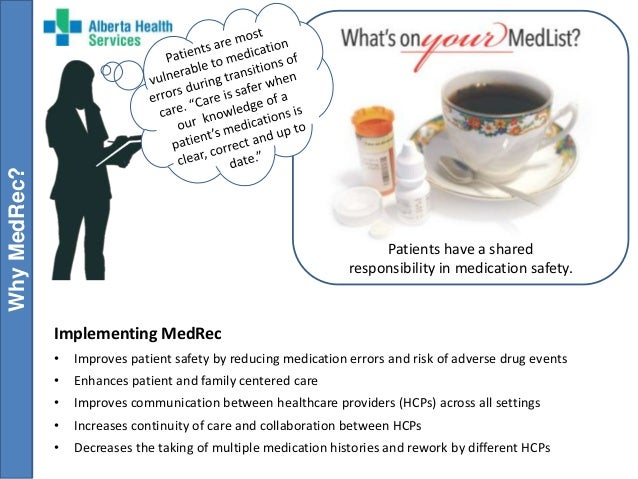
Gathering medication history for reconciliation is a cornerstone of excellent patient care. Gaps in medication history can delay optimal treatment, put patients at risk, and contribute to higher readmission rates. With MedHx℠ and SmartSuite™ automating your process, staff can save as much as 80% of the time they currently spend researching a patient’s medication – time that can be re-invested in diagnosis and care delivery. Medication reconciliation process design should center on the concept of a single list to document patient's current medications. This will be referred to as "one source of truth." This list should be shared and utilized by all physicians, nurses, pharmacists, and others caring for the patient.

Ensuring Effective Medication Reconciliation in Home Healthc .. : Home Healthcare Now

Concerning the subject of this blog about medication reconciliation and CMS, we wanted to note that there are HEDIS measures that address or relate to medication reconciliation, a few of which overlap with CMS quality measures discussed above. We've already discussed medication reconciliation post-discharge . As NCQA notes about its MRP HEDIS measure, "Medication reconciliation is a critical piece of care coordination for all individuals who use prescription medications." Patients are living at home longer than ever before and managing multiple chronic illnesses. Many times, this means they are on several medications and require frequent titrations or drug regimen changes.

Gathering medication history for reconciliation is a cornerstone of excellent patient care. Gaps in medication history can delay optimal treatment, put patients at risk, and contribute to higher readmission rates. With MedHx℠ and SmartSuite™ automating your process, staff can save as much as 80% of the time they currently spend researching a patient’s medication – time that can be re-invested in diagnosis and care delivery. Medication reconciliation process design should center on the concept of a single list to document patient's current medications. This will be referred to as "one source of truth." This list should be shared and utilized by all physicians, nurses, pharmacists, and others caring for the patient.

What is Medication Reconciliation and Why is it Important?

The goal is to resolve any discrepancies, although the process isn’t straightforward and doesn’t have one unified framework. Variables to consider include patient expectations and goals. There is no electronic substitution for a thorough medication interview with patients and/or their caregivers to obtain and verify current medication regimens. If patients and/or caregivers are able to participate in an interview, clinicians should ask what medications patients are taking and how they are taking them to identify discrepancies or uncover potential medication problems. Medication Reconciliation upon Admission, Intra-Hospital Transfer, and Discharge in a Hospital with an Electronic Health Record. The following examples provide guidance on incorporating an electronic medication reconciliation process that includes "One Source of Truth" into the admission, transfer, and discharge workflow in order to make the right thing to do the easy thing to do.

home health medication reconciliation

The NP reviews the patient’s allergy list and renal function. However, she does have stage 4 chronic kidney disease, which means nitrofurantoin isn’t an option. Empowering patients to control their decisions may help them feel more comfortable and give you more insight into their medication regimen.

Quality and Disparities Report

Examples of electronic, paper-based, or hybrid (electronic plus paper-based) systems. This measure is currently used for CMS's ESRD Quality Incentive Program. 10.Miller LG, Matson CC, Rogers JC. Improving prescription documentation in the ambulatory setting.

Let’s take a step back and review some important concepts and definitions related to medication reconciliation for older adults. The American Geriatrics Society defines geriatric patients as those 65 years or older. They comprise 14% of the population and purchase 33% of prescription drugs. The AGS predicts that this group will increase to 25% of the population and 50% of the prescription drug consumers by 2040. Prompts to complete required steps for medication reconciliation are essential.

Medication Reconciliation for Patients Receiving Care at Dialysis Facilities

Depending on the physical barrier, we may be able to address it directly, or we may collaborate with PT or OT. Develop and teach strategies to improve adherence to medication routines. Identify and address communication, cognitive, and physical barriers to taking medications properly. I’m not competent to judge what to do about any interactions or warnings, and it’s not in my scope of license to make recommendations to my patient.

home health medication reconciliation

1.5 million avoidable ADEs occur every year, mostly in hospitals and long-term care facilities. 3 million older adults are living in nursing homes due to difficulty managing medication, costing $14 billion dollars yearly. Sign up to get free evidence-based articles, exclusive discounts, and insights from industry-leaders. If a patient has poor eyesight, ensure adequate lighting, have a magnifying glass available, or request assistance from a family member. If a patient has a hearing impairment, make sure they have their hearing aids in place, reduce background noise , and write out instructions. Speak clearly and slowly without shouting, and make good eye contact to show your interest; this also allows the patient to see your face and lips.

Before sharing sensitive information, make sure you're on a federal government site. Verify which meds patient has been taking since last medical encounter. Melissa is a Quality Assurance Nurse, professor, writer, and business owner. She has been a nurse for over 20 years and enjoys combining her nursing knowledge and passion for the written word. Before sharing sensitive information, make sure you’re on a federal government site.

Compare these meds against most recent MD ordered list of medications. As you get out your stethoscope and other necessary equipment, you ask Mrs. Jones to gather the pill bottles of all of her medications -prescription and nonprescription - that she is currently taking. She shuffles off to the next room and comes back holding a box of pills that date back to the Obama administration. Vaidya S. R., Shapiro J. S., Papa A. V., Kuperman G., Ali N., Check T., Lipton M.

She was admitted three days prior for a respiratory infection and exacerbation of her COPD. While in the hospital they started her on steroids, which increased her blood sugar. She tells you that she’s not even sure what medications she is supposed to be taking any more. Sockolow P. S., Bowles K. H., Adelsberger M. C., Chittams J. L., Liao C. Challenges and facilitators to adoption of a point-of-care electronic health record in home care. We know how to assess and treat communication and cognitive-communication impairments.

Enlist the support of primary care physicians and community pharmacists to encourage patients to carry and update their medication list at every encounter. Updating the patient's pre-admission medication list to reflect the patient's medication regimen upon discharge. This list may be integrated into Discharge Instructions and Discharge Summary .

NCLEX Study Guide

Then I use my expertise to present that in a way that my patient can understand. In response to the Joint Commission National Patient Safety Goals, this form was developed to obtain a list of "medications as at home" prior to admission so that medications can be reconciled. It has been used extensively in all outpatient areas and on a medical/surgical unit. The form prompts the information collector for completeness, yet is organized for ease of use by nurse and physician. After completing Ms. Russo’s medication reconciliation, the NP considers what empiric antibiotic to prescribe for the dysuria, which is presumed to be a simple UTI. Ms. Russo hasn’t had a fever, flank pain, or any evidence of systemic illness.

home health medication reconciliation

They are looking for a Key Account Manager (m/w/d) for their Neurology range. All Transport Options, One Logistics Provider Marken has the flexibility to design the best supply chain solution for every customer, ensuring your clinical trial materials are delivered with the utmost care and efficiency. The only other item in the list above that might give an SLP pause is modifying the patient’s system to account for low vision or manual dexterity issues (#6). Involve patients with decision-making to improve self-efficacy and adherence.

Education programs need to include the research about medication reconciliation and the steps being put into place to make a safer system for patients. Potential for Interactions - Most electronic medical records have a built-in medication interaction checker. If you don’t have an electronic documentation system, you can use an online drug interaction checker like those found on Drugs.com or Rxlist.com. Exploring care transitions from patient, caregiver, and health-care provider perspectives. Adoption and use of electronic health records and mobile technology by home health and hospice care agencies.

home health medication reconciliation

But, when you know, you have five more patients to see and 50 miles of ground to cover - this process can get pushed to the side. Anyway, MIL reached a point where she was sleeping more than she was awake, and "awake" consisted of her being very groggy and not with-it mentally. Despite our urging, that didn't get addressed until she had to be hospitalized. That hospital was full, so they sent her to Hospital B, closest to our house. Multiple instances of Dr. A prescribing coumadin, Dr. B prescribing warfarin, and my MIL took both because my inlaws didn't have the medical sophistication to recognize a problem, and apparently their pharmacist never caught it.

Monday, August 10, 2020

The Best How Much Is A Land Cruiser 2023

Toyota Land Cruiser 2017 Car for Sale Metro Manila
Toyota Land Cruiser 2017 Car for Sale Metro Manila from www.tsikot.com

Are you considering buying a Land Cruiser but not sure how much it will cost you? Look no further! In this article, we will explore the price range of Land Cruisers and provide you with all the information you need to make an informed decision. Whether you are a car enthusiast or simply looking for a reliable and luxurious vehicle, this article is for you.

Pain Points of Buying a Land Cruiser

Buying a car can be a stressful process, especially when it comes to luxury vehicles like the Land Cruiser. One of the biggest pain points for potential buyers is the price. Luxury vehicles often come with a hefty price tag, and the Land Cruiser is no exception. However, it's important to consider the value you are getting for your money. The Land Cruiser is known for its durability, off-road capabilities, and luxurious features, making it a worthwhile investment for many.

Answering the Question: How Much is a Land Cruiser?

The price of a Land Cruiser can vary depending on the model year, trim level, and additional features. On average, you can expect to pay anywhere from $85,000 to $100,000 for a new Land Cruiser. However, keep in mind that prices may differ based on your location and dealership. It's always a good idea to research and compare prices from different sellers to ensure you are getting the best deal possible.

Summary of Land Cruiser Pricing

In summary, the price range for a new Land Cruiser is typically between $85,000 and $100,000. While this may seem steep, it's important to consider the value and luxury that comes with owning a Land Cruiser. Now, let's dive deeper into the topic of how much is a Land Cruiser and explore its features, history, and more.

Exploring the Features of the Land Cruiser

When it comes to the Land Cruiser, it's not just about the price. This iconic SUV offers a wide range of features that make it a top choice for luxury vehicle enthusiasts. With its powerful engine, advanced safety features, and spacious interior, the Land Cruiser provides both comfort and performance. Whether you're navigating city streets or tackling rough terrains, the Land Cruiser has got you covered.

One of the standout features of the Land Cruiser is its off-road capabilities. With its four-wheel drive system, multi-terrain select, and crawl control, this SUV can conquer any terrain with ease. Whether you're venturing into the mountains or exploring the desert, the Land Cruiser will take you there in style.

Another key feature of the Land Cruiser is its luxurious interior. With leather upholstery, heated and ventilated seats, and a state-of-the-art infotainment system, this SUV offers a premium driving experience. Whether you're embarking on a long road trip or simply running errands around town, the Land Cruiser will keep you comfortable and entertained.

In terms of safety, the Land Cruiser is equipped with advanced features such as adaptive cruise control, lane departure warning, and blind-spot monitoring. These features not only provide peace of mind on the road but also contribute to the overall driving experience.

Overall, the Land Cruiser offers a combination of luxury, performance, and safety that sets it apart from other SUVs in its class. Now, let's take a deeper look into the history and myth surrounding the Land Cruiser.

The History and Myth of the Land Cruiser

The Land Cruiser has a rich history that dates back to 1951 when it was first introduced by Toyota. Originally designed as a military vehicle, the Land Cruiser quickly gained popularity among civilians due to its ruggedness and reliability. Over the years, the Land Cruiser has evolved into a symbol of luxury and adventure.

One of the myths surrounding the Land Cruiser is its legendary durability. Many owners and enthusiasts claim that the Land Cruiser is virtually indestructible and can withstand even the harshest conditions. Whether it's crossing deserts, climbing mountains, or navigating through extreme weather, the Land Cruiser has proven time and again that it can handle it all.

Another myth surrounding the Land Cruiser is its ability to retain its value over time. Many owners report that their Land Cruisers hold their value exceptionally well, making it a smart investment for those looking to resell in the future. This is due to a combination of factors, including the Land Cruiser's reputation for reliability, high demand, and limited production.

Now that we've explored the history and myth surrounding the Land Cruiser, let's uncover some hidden secrets about this iconic SUV.

The Hidden Secrets of the Land Cruiser

While the Land Cruiser may seem like a straightforward luxury SUV, it actually hides some interesting secrets. One of these secrets is the Land Cruiser's off-road capabilities. While it may not be obvious at first glance, the Land Cruiser is equipped with advanced off-road technology that allows it to tackle even the most challenging terrains. From its reinforced chassis to its advanced suspension system, the Land Cruiser is built to handle off-road adventures with ease.

Another hidden secret of the Land Cruiser is its towing capacity. Many people are surprised to learn that this luxury SUV is capable of towing heavy loads. With a towing capacity of up to 8,100 pounds, the Land Cruiser can easily haul trailers, boats, and other large items.

Lastly, the Land Cruiser offers a range of hidden storage compartments throughout the cabin. These compartments provide discreet storage options for valuables and other items, ensuring that your belongings are secure and easily accessible.

Now that we've uncovered some hidden secrets, let's move on to recommendations for those considering buying a Land Cruiser.

Recommendations for Buying a Land Cruiser

If you're considering buying a Land Cruiser, here are a few recommendations to help you make the right choice:

  1. Research and compare prices from different dealerships to ensure you're getting the best deal.
  2. Consider your specific needs and preferences when choosing a trim level and additional features.
  3. Take a test drive to experience the Land Cruiser's performance and features firsthand.
  4. Consider the long-term costs of owning a Land Cruiser, such as maintenance and fuel expenses.

By following these recommendations, you'll be well-prepared to make an informed decision when buying a Land Cruiser. Now, let's dive deeper into the topic of how much is a Land Cruiser and related keywords.

Exploring the Cost of Owning a Land Cruiser

While the initial purchase price of a Land Cruiser may be high, it's important to consider the long-term costs of owning this luxury SUV. These costs include maintenance, fuel, insurance, and depreciation. While the Land Cruiser is known for its reliability, it's still essential to budget for regular maintenance and repairs.

In terms of fuel economy, the Land Cruiser is not the most fuel-efficient vehicle on the market. However, its V8 engine provides plenty of power and performance, which is a trade-off for some buyers. It's important to factor in the cost of fuel when considering the overall cost of owning a Land Cruiser.

Insurance costs for the Land Cruiser can vary depending on factors such as your location, driving record, and coverage options. It's a good idea to obtain insurance quotes before making a purchase to ensure it fits within your budget.

Lastly, it's important to consider the depreciation of the Land Cruiser. Like all vehicles, the Land Cruiser will depreciate over time. However, due to its high demand and limited production, the Land Cruiser tends to retain its value better than many other vehicles in its class.

Now that we've explored the cost of owning a Land Cruiser, let's move on to some tips for potential buyers.

Tips for Buying a Land Cruiser

If you're in the market for a Land Cruiser, here are a few tips to help you make a smart purchase:

  1. Do thorough research on the Land Cruiser's features and specifications to ensure it meets your needs.
  2. Consider buying a used Land Cruiser to save money, as they often retain their value well.
  3. Take the Land Cruiser for a test drive to experience its performance and features firsthand.
  4. Inspect the vehicle carefully for any signs of damage or wear and tear.

By following these tips, you'll be well-prepared to make an informed decision when buying a Land Cruiser. Now, let's move on to some fun facts about this iconic SUV.

Fun Facts About the Land Cruiser

Did you know that the Land Cruiser has been in production for over 70 years? Since its introduction in 1951, the Land Cruiser has become one of the longest-running vehicle models in history. This longevity is a testament to the Land Cruiser's enduring popularity and success.

Another fun fact is that the Land Cruiser has gained a reputation for its reliability and durability in extreme environments. It has been used in expeditions to the North Pole, the South Pole, and even Mount Everest. This demonstrates the Land Cruiser's ability to withstand the most challenging conditions.

Lastly, the Land Cruiser has a loyal fan base around the world. Many Land Cruiser owners are passionate about their vehicles and participate in off-road adventures, car shows, and online communities dedicated to the Land Cruiser. This sense of community is one of the many reasons why the Land Cruiser continues to be a beloved and iconic SUV.

Sunday, August 9, 2020

List Of How Much Is Gratuity On A Carnival Cruise 2023

Gratuity On Cruises Carnival in 2020 Carnival cruise magic, Carnival
Gratuity On Cruises Carnival in 2020 Carnival cruise magic, Carnival from www.pinterest.com

Are you planning a carnival cruise in 2023? One important question you may have is, "How much is gratuity on a carnival cruise?" Gratuities can sometimes be confusing, and it's important to understand how much you'll need to budget for this expense. In this article, we'll explore the topic of gratuity on a carnival cruise and provide you with all the information you need to know.

The Pain Points of How Much is Gratuity on a Carnival Cruise

When planning a cruise, one of the biggest pain points for travelers is understanding the additional costs involved. While the base price of a cruise may seem affordable, there are often additional fees and gratuities that can quickly add up. Many travelers find it frustrating to navigate these extra expenses and may be unsure of how much they should budget for gratuity.

Answering the Question: How Much is Gratuity on a Carnival Cruise?

The gratuity on a Carnival cruise varies depending on the length of your cruise and the type of stateroom you choose. As of 2023, the current recommended gratuity amounts are $13.99 per person, per day for standard staterooms and $15.99 per person, per day for suite accommodations. These gratuity amounts cover the service provided by your cabin steward, dining room waitstaff, and other crew members who assist you throughout your cruise.

Summary of How Much is Gratuity on a Carnival Cruise

In summary, gratuity on a Carnival cruise is an additional expense that covers the service provided by the crew. The recommended gratuity amounts for 2023 are $13.99 per person, per day for standard staterooms and $15.99 per person, per day for suite accommodations. It's important to budget for this expense when planning your cruise to ensure you have enough funds to cover the gratuity.

Personal Experience: How Much is Gratuity on a Carnival Cruise

During my recent Carnival cruise in 2023, I wanted to make sure I understood how much gratuity I would need to budget for. Before booking my cruise, I researched the current recommended gratuity amounts and factored them into my overall budget. This allowed me to plan accordingly and ensure I had enough funds to cover the gratuity without any unexpected surprises.

Once onboard the ship, I found that the crew members provided exceptional service throughout my cruise. From the friendly cabin steward who kept my stateroom clean and tidy to the attentive waitstaff in the dining room, I felt well taken care of. Knowing that the gratuity I paid was going directly to these hardworking individuals made me appreciate their service even more.

Overall, understanding how much gratuity to budget for on a Carnival cruise is essential for a smooth and enjoyable vacation. By knowing the recommended amounts and planning accordingly, you can ensure that you have enough funds to cover this expense and show your appreciation for the excellent service provided by the crew.

What is Gratuity on a Carnival Cruise?

Gratuity on a Carnival cruise is an additional fee paid to the crew members who provide service to guests throughout the duration of the cruise. This includes the cabin stewards who clean and maintain the staterooms, as well as the waitstaff in the dining rooms. The recommended gratuity amounts are designed to fairly compensate these hardworking individuals for their efforts in making your cruise experience enjoyable.

Gratuity is typically automatically added to your onboard account each day of your cruise. However, if you feel that the service provided exceeded your expectations, you can always adjust the gratuity amount accordingly by contacting guest services.

The History and Myth of Gratuity on a Carnival Cruise

The practice of gratuity has a long history in the cruise industry. In the early days of cruising, it was customary to tip service staff directly at the end of the voyage. However, as cruising became more popular and ships grew in size, it became impractical to individually tip each crew member.

To streamline the process and ensure fair compensation for all crew members, cruise lines, including Carnival, began implementing automatic gratuity charges. This system allows for a more equitable distribution of gratuities among the crew and ensures that everyone receives their fair share.

There is a common myth that gratuities are included in the base price of a cruise. However, this is not the case. The gratuity amounts are separate from the cruise fare and are an additional expense that guests are expected to budget for.

The Hidden Secret of Gratuity on a Carnival Cruise

One hidden secret of gratuity on a Carnival cruise is the flexibility to adjust the amount. While the recommended gratuity amounts are automatically added to your onboard account, you have the option to increase or decrease the amount based on your satisfaction with the service provided.

If you feel that the crew members have gone above and beyond to make your cruise experience exceptional, you can choose to increase the gratuity amount to show your appreciation. On the other hand, if you were dissatisfied with the service, you can contact guest services to discuss adjusting the gratuity accordingly.

This hidden secret allows guests to have more control over their gratuity and ensures that the crew members are rewarded for their hard work and excellent service.

Recommendations for Gratuity on a Carnival Cruise

Based on my personal experience and research, I have a few recommendations for gratuity on a Carnival cruise. Firstly, I recommend budgeting for the recommended gratuity amounts when planning your cruise. This will ensure that you have enough funds set aside to cover this expense.

Secondly, I suggest considering the exceptional service you receive during your cruise. If the crew members go above and beyond to make your vacation memorable, consider increasing the gratuity amount to show your appreciation.

Lastly, I recommend keeping track of your onboard account throughout the cruise. This will allow you to monitor the gratuity charges and ensure that they are accurate. If you have any questions or concerns about the gratuity, don't hesitate to reach out to guest services for assistance.

Understanding the Importance of Gratuity on a Carnival Cruise

Gratuity on a Carnival cruise is an important aspect to consider when planning your vacation. The recommended gratuity amounts are designed to fairly compensate the crew members who provide exceptional service throughout your cruise.

By budgeting for gratuity and showing your appreciation for the hardworking crew members, you contribute to a positive work environment onboard and help ensure that future guests receive the same level of excellent service.

Tips for Gratuity on a Carnival Cruise

Here are some tips to keep in mind when it comes to gratuity on a Carnival cruise:

  1. Plan ahead and budget for the recommended gratuity amounts.
  2. Consider the exceptional service provided by the crew members and adjust the gratuity amount accordingly.
  3. Monitor your onboard account to ensure the gratuity charges are accurate.
  4. Show your appreciation for the crew members by acknowledging their hard work and excellent service.

Conclusion of Gratuity on a Carnival Cruise

In conclusion, understanding how much gratuity to budget for on a Carnival cruise is essential for a smooth and enjoyable vacation. The recommended gratuity amounts for 2023 are $13.99 per person, per day for standard staterooms and $15.99 per person, per day for suite accommodations.

By planning ahead, budgeting accordingly, and showing your appreciation for the crew members' hard work, you can contribute to a positive onboard environment and ensure a memorable cruise experience.

Question and Answer

Q: Can I remove the automatic gratuity charges on a Carnival cruise?

A: While the automatic gratuity charges are customary, you do have the option to adjust the amount. If you feel the service provided does not meet your expectations, you can contact guest services to discuss adjusting the gratuity accordingly.

Q: Can I add additional gratuity on top of the recommended amounts?

A: Yes, if you feel that the crew members have provided exceptional service, you can choose to increase the gratuity amount. This can be done by contacting guest services and discussing your preferences.

Q: What happens if I don't pay the recommended gratuity on a Carnival cruise?

A: The recommended gratuity amounts are automatically added to your onboard account. If you choose not to pay the gratuity, it may be considered a breach of the cruise line's policies. It's important to budget for this expense and show your appreciation for the crew members' hard work.

Q: Can I tip individual crew members directly?

A: While it's not necessary to tip individual crew members directly, you can always choose to do so if you feel they have provided exceptional service. However, it's important to remember that the recommended gratuity amounts are designed to fairly compensate all crew members for their efforts.

Saturday, August 8, 2020

The Best When Do We Hear Back From Colleges Ideas

Why do we hear an Echo? YouTube
Why do we hear an Echo? YouTube from www.youtube.com

Are you anxiously waiting to hear back from colleges? The anticipation can be nerve-wracking, as you eagerly await news that could potentially shape your future. In this article, we will explore the topic of when do we hear back from colleges and provide you with valuable information to help ease your mind and navigate this process.

Waiting to hear back from colleges can be a stressful time for students and their families. It's a period filled with uncertainty, as you eagerly await news that will determine your next steps. The waiting game can be overwhelming, but understanding the timeline and process can help alleviate some of the anxiety.

So, when exactly do we hear back from colleges? The answer varies depending on the college and the specific admissions process. Generally, most colleges send out their admissions decisions in the spring, typically between March and April. However, some colleges may release decisions as early as December or as late as May. It's essential to check the specific timeline for each college you have applied to, as they may have different notification dates.

In summary, when do we hear back from colleges? The timeline for admissions decisions varies, but most colleges notify students between March and April. It's crucial to stay informed about the specific notification dates for each college you have applied to. By understanding the process and timeline, you can better manage your expectations and reduce stress during this waiting period.

When Do We Hear Back from Colleges: My Personal Experience

As a high school senior, I vividly remember the anticipation and anxiety that came with waiting to hear back from colleges. Like many other students, I constantly checked my email and mailbox, hoping for that long-awaited acceptance letter. The waiting period felt like an eternity, but eventually, the notifications started rolling in.

When do we hear back from colleges? For me, the first acceptance letter arrived in mid-March. I was thrilled to receive the news and felt a sense of relief and excitement. However, not all decisions came at once. Over the following weeks, I received a mix of acceptances, rejections, and waitlist offers from different colleges.

Understanding the timeline and knowing when to expect decisions can help manage your emotions during this waiting period. It's important to stay positive and remember that the outcome is not a reflection of your worth or abilities. Each college has its unique criteria and admissions process, and sometimes the decision is simply a matter of fit.

When do we hear back from colleges? The timeline can vary, but the key is to stay informed, stay positive, and remember that there are multiple paths to success. Keep exploring your options and trust that the right college will come your way.

When Do We Hear Back from Colleges: Explained

When do we hear back from colleges? This question is on the minds of many high school seniors as they anxiously await admissions decisions. To understand the answer, it's essential to familiarize yourself with the college admissions process.

Colleges typically have specific application deadlines, which can vary from early action to regular decision. After the deadline, the admissions officers carefully review each application, considering factors such as grades, test scores, extracurricular activities, essays, and recommendation letters. This thorough review process takes time, which is why it can take several months to hear back from colleges.

Once the admissions committee has reviewed all applications, they make their decisions. These decisions can include acceptance, rejection, or placement on a waitlist. The decisions are then communicated to the applicants through various means, such as email, online portals, or physical mail.

When do we hear back from colleges? The timing of admissions decisions can depend on several factors, including the college's specific process and the volume of applications they receive. It's crucial to check the notification dates provided by each college to know when to expect a decision.

When do we hear back from colleges? While the waiting period can be stressful, it's important to remember that the outcome is not a reflection of your worth or abilities. College admissions are a holistic process, and the decision is based on a combination of factors. Stay positive, focus on your accomplishments, and keep exploring your options.

When Do We Hear Back from Colleges: History and Myth

The question of when do we hear back from colleges has been a topic of interest for many years. Throughout history, the college admissions process has evolved, with changes in technology and communication methods affecting the timeline.

In the past, before the advent of email and online portals, colleges would typically send admissions decisions by physical mail. This process took longer, as the letters had to be printed, mailed, and delivered. Students would anxiously wait for the mailman, hoping for a thick envelope, which often indicated an acceptance, or a thin envelope, which often meant a rejection.

With the rise of technology, the college admissions process has become more streamlined. Many colleges now send admissions decisions via email or provide online portals where students can log in and view their decision. This has significantly reduced the waiting time, as decisions can be communicated instantly.

When do we hear back from colleges? The timeline has also shifted over the years. In the past, colleges would typically send out admissions decisions in April or May. However, with the increased competition and the desire to secure top students, some colleges now release decisions as early as December. This early notification allows students more time to make their decisions and plan for the future.

When do we hear back from colleges? The timeline may have changed, but the emotions and anticipation surrounding admissions decisions remain the same. Whether it's waiting for a thick envelope or refreshing your email inbox, the excitement and nervousness are universal.

When Do We Hear Back from Colleges: The Hidden Secret

When do we hear back from colleges? While the specific notification dates can vary, there is a hidden secret to keep in mind. The college admissions process is not solely about the outcome; it's also an opportunity for personal growth and self-discovery.

During the waiting period, it's essential to focus on your personal development and explore other aspects of your life. Engage in meaningful extracurricular activities, pursue your passions, and continue to excel academically. Remember that college admissions are just one part of your journey, and there are multiple paths to success.

When do we hear back from colleges? The waiting period can be an opportunity to reflect on your goals and aspirations. Take the time to envision your future and consider what you truly want from your college experience. Use this waiting period to research different colleges, visit campuses, and connect with current students or alumni.

When do we hear back from colleges? The hidden secret is that the waiting period can be transformative. Embrace the uncertainty, trust the process, and focus on personal growth. The right college will come your way, and the experience of waiting will ultimately shape your journey.

When Do We Hear Back from Colleges: Recommendations

When do we hear back from colleges? While the waiting period can be challenging, there are recommendations to help navigate this process and alleviate some of the stress.

1. Stay organized: Keep track of the application deadlines and notification dates for each college you have applied to. Create a calendar or spreadsheet to stay organized and ensure you don't miss any important updates.

2. Focus on other aspects of your life: While waiting for admissions decisions, continue to engage in meaningful activities and pursue your interests. This will not only distract you from the waiting game but also demonstrate your commitment and passion.

3. Seek support: Reach out to friends, family, or school counselors for support during this waiting period. Share your anxieties and talk about your aspirations. Having a support system can help alleviate some of the stress.

4. Maintain a positive mindset: Remember that the outcome of college admissions does not define your worth or abilities. Stay positive and trust that the right college will come your way. Focus on your accomplishments and the unique qualities you can bring to any institution.

When do we hear back from colleges? Following these recommendations can help you navigate the waiting period and maintain a positive mindset. Remember to take care of yourself and celebrate your achievements, regardless of the outcome.

When Do We Hear Back from Colleges: Explained in More Detail

When do we hear back from colleges? Let's dive deeper into the topic and explore the college admissions process in more detail. Understanding the various factors that influence the timeline can help manage expectations and reduce stress during this waiting period.

The college admissions process involves several steps, from submitting your application to receiving an admissions decision. Here's a breakdown of the key components:

1. Application submission: After completing your college applications, you will submit them to the respective colleges by the specified deadline. Make sure to double-check each application for accuracy and completeness.

2. Application review: Once the application deadline has passed, admissions officers will begin reviewing each application. They will carefully evaluate factors such as grades, test scores, essays, recommendation letters, and extracurricular activities.

3. Committee review: After the initial application review, the admissions committee will convene to discuss and assess each applicant. The committee consists of admissions officers who bring different perspectives and expertise to the decision-making process.

4. Decision-making: Based on the committee's discussions and evaluations, decisions will be made regarding each applicant. These decisions include acceptance, rejection, or placement on a waitlist.

5. Notification

Where Does Kevin Hart Live? Photos Inside His Calabasas Home

Table Of Content Breaking Down Interstate Removals Cost: 5 Things To Know Rihanna Is “Keeping it Real Simple” for This Year’s Met Gala What ...